

TOYO TIRE Materiality
In promoting sustainability, we believe it important to identify issues that should be given priority when considering factors such as the relevant scope of our business domain and internal resource limitations. We have thus established our Group material issues, which were decided upon by the Sustainability Committee in June 2021 and then approved by the Executive Committee in July.
Along with strategically investing our internal resources into initiatives related to the material issues, we will also use this opportunity to foster a corporate culture where each employee addresses sustainability issues by connecting materiality to their own duties, as well as strengthen materiality-focused stakeholder engagement, such as public ESG dialogues.
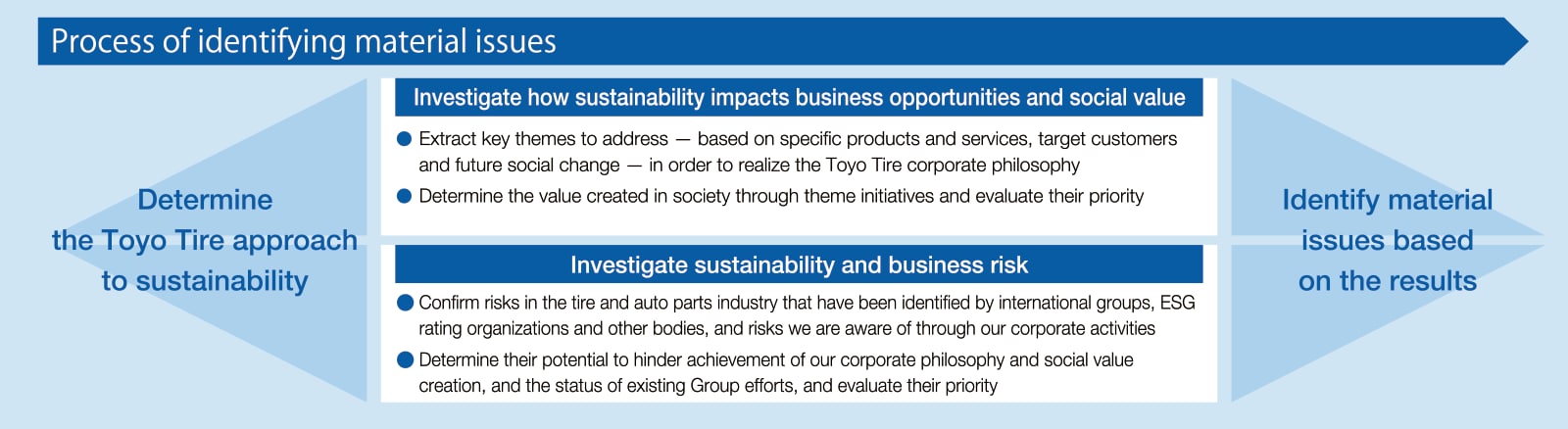
Process of identifying material issues
After declaring our intention to integrate sustainability into corporate management in the Medium-Term ’21 Plan, we immediately established a sustainability steering committee formed of the president and vice presidents of each headquarters to begin identifying material issues in February 2021. This steering committee was then formally reorganized as the Sustainability Committee in April, and a total of four sessions were held over four months from February to May of that year. Also in May, discussions on the same topic took place between a total of 40 division general managers and other executives who are key to advancing sustainability. The outcomes of these discussions were then fed back for further deliberation by the Committee.
Process of identifying material issues
Process of setting targets and KPIs
Based on our Sustainability Policy, we have set specific activity themes for each material issue and formulated medium- to long-term targets and goals for each theme, as well as processes and measures to achieve them. To set targets and goals, we first considered the vision of what we would like the Group and society to achieve in the long-term (by 2030), and made these our “Vision Goals.” We then established “Vision KPIs” as benchmarks to confirm our progress on the way towards these goals.
For the medium- (as of 2025) and short-term, we worked backwards from 2030 to plan the intermediate processes and measures needed to achieve these goals, which will be built into annual policies and business plans, and progress managed.
As 2025 marked the final year of our short-term sustainability goals, we conducted a review of our target years, activity themes and KPIs. We have now readjusted our specific goals and metrics, accounting for potential changes in the external environment over the long term (2035) and medium term (2030), to align them with the strategies outlined in our Medium-Term ’26 Plan.
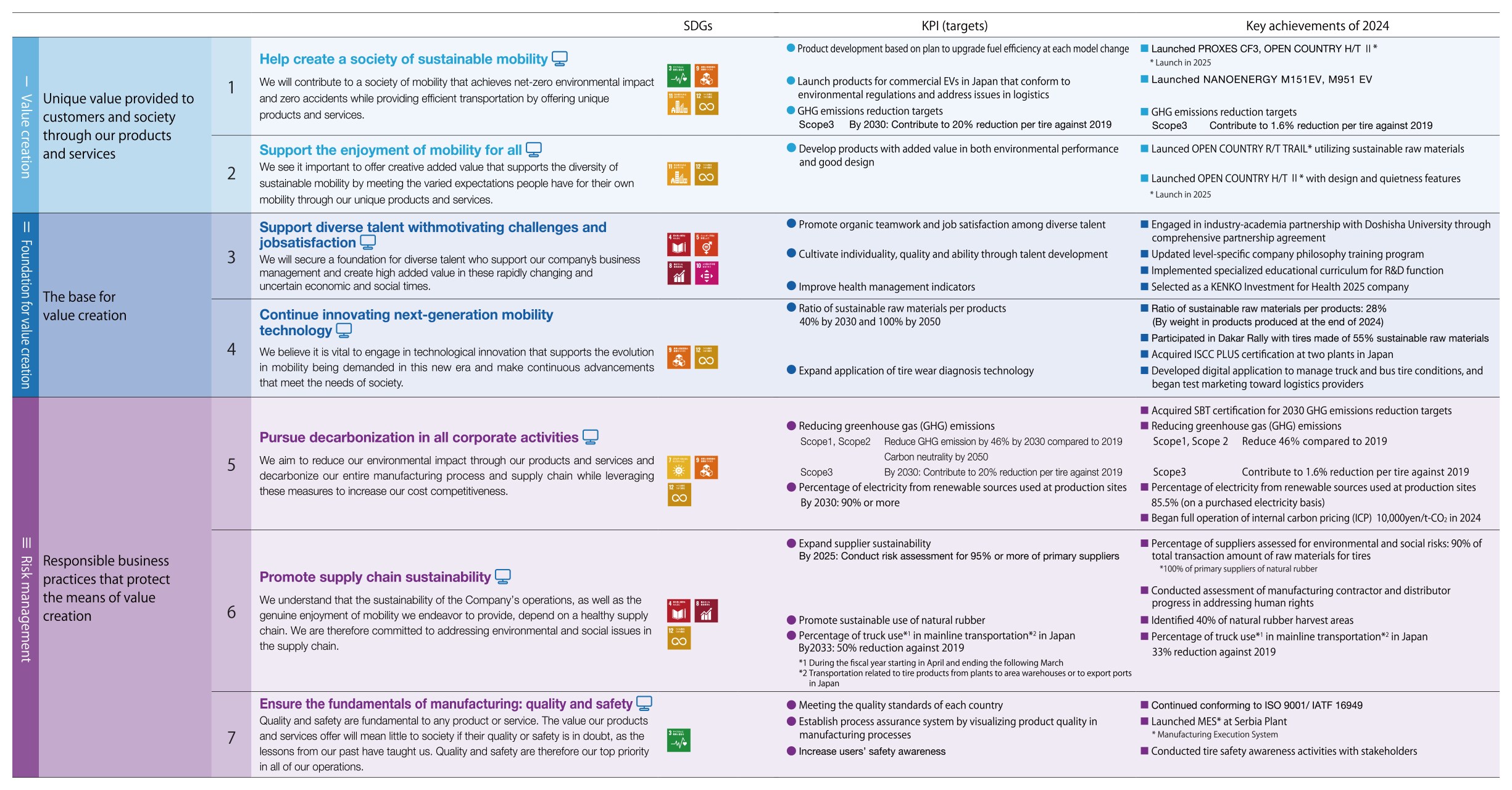
Activity themes linked to material issues
As our materiality is formed of the key priority issues of the Group, we have set up task forces as sub organizations within the Sustainability Committee, and are also using existing company-wide structures and meetings to set targets and KPIs for each theme, and plan processes and measures to achieve them. After approval of these by the Sustainability Committee and Executive Committee, each headquarters will incorporate them into their annual policies and business plans and carry them out.
 Click to enlarge
Material issues
DomainⅠ Value creation Unique value provided to customers and society through our products and services
-

1. Help create a society of sustainable mobility
We recognize that the sustainability of tire and automotive parts manufacturers can only be ensured through a society of sustainable mobility. We will thus fulfil our duty in using our unique products and services to help establish a society of sustainable mobility that boasts net-zero environmental impact, zero accidents and efficient transportation.
-

2. Support the enjoyment of mobility for all
We see it important to offer creative added value that supports the diversity of a society of sustainable mobility by fulfilling the essential conditions for sustainability (environmental compliance, safety) while also meeting the varied expectations people have for their own mobility through our unique products and services.
DomainⅡ Foundation for value creationThe base for value creation
-

3. Support diverse talent with motivating challenges and job satisfaction
We seek individuals who can equip themselves with the medium- to long-term perspective of a tire and automotive parts manufacturer, think creatively and flexibly, and show initiative and ambition. We will secure a foundation for diverse talent who support our company’s business management and create high added value in these rapidly changing and uncertain economic and social times.
-

4. Continue innovating next-generation mobility technology
The value we provide through our products and services must support the evolution in mobility being demanded in this new era. To make this happen, we believe it is vital to engage in ongoing technological innovation and make continuous advancements that meet the demands of society.
DomainⅢ Risk management Responsible business practices that protect the means of value creation
-

5. Pursue decarbonization in all corporate activities
Our Group will adjust its course to match that of global society, including Japan, business communities and industries in sharing the same targets towards decarbonization, and work united as a company in tackling this key issue. We will not only aim to eliminate the environmental impact of mobility through our products and services, but also to decarbonize our entire manufacturing process and supply chain, and tie these measures to increased cost competitiveness.
-

6. Promote supply chain sustainability
We understand that our own sustainability cannot be ensured without the sustainability of our suppliers of natural rubber and other raw materials, and that the genuine enjoyment of mobility is created through a healthy supply chain. We thus see environmental and social issues in the supply chain as key challenges that we will prioritize in our efforts.
-

7. Ensure the fundamentals of manufacturing: quality and safety
No matter how much value a product or service may create, if it cannot maintain a strong core of quality and safety, it is no longer able to offer that significance or value to society. Quality and safety are therefore our top priority in all of our operations, building on lessons we have learned in the past.
-
DomainⅠ
Value creation -
DomainⅡ Foundation for value creation
-
DomainⅢ Risk management