
External Environment and Risks & Opportunities
Taking into account anticipated changes in the business environment over the five-year period of the Medium-Term ’26 Plan, we will identify the risks and opportunities that may affect our business, adapt to them, and create value for society through our unique products, services, and targeted initiatives.
External environment
Politics and economics
- Expansion of geopolitical risks
- Accelerated nationalism, decline of international cooperation
- Rising inflationary pressures primarily in the U.S. and Japan
- Increased fluctuations in resource and energy prices
Environment
- Uncertainty associated with environmental regulatory trends
- Progressing decarbonization
- Transition to a circular economy
- Growing interest in natural capital
Society
- Greater use of AI/IT (mobility-related data linking)
- Changing working population and composition
- Growing importance of human capital
- Upholding human rights in the supply chain
- Increasing demand for labor-saving measures and greater efficiencies in the logistics sector
- High quality- and safety-related demands
Risks & Opportunities
Opportunity
- Expanding market opportunities where environment-conscious technologies and design quality are highly valued
- Increase in low-emission vehicles in light of environmental and social issues in the logistics industry
- Demand for maintenance-free features in next-generation transportation services
- Continued popularity of SUVs and pickup trucks in the U.S.
Risk
- Uncertainty surrounding business operations due to geopolitical tensions
- Rising costs due to soaring renewable energy prices and purchase of carbon credits
- Increasing uncertainty surrounding prices of raw materials derived from fossil fuels
- Increased cost of establishing traceability systems
- Difficulty securing quality human capital in sufficient numbers
- Expanding demands to address environmental issues and human rights violations in the supply chain
- Rising costs associated with development of technical responses and quality control/assurance systems
Value Creation Process
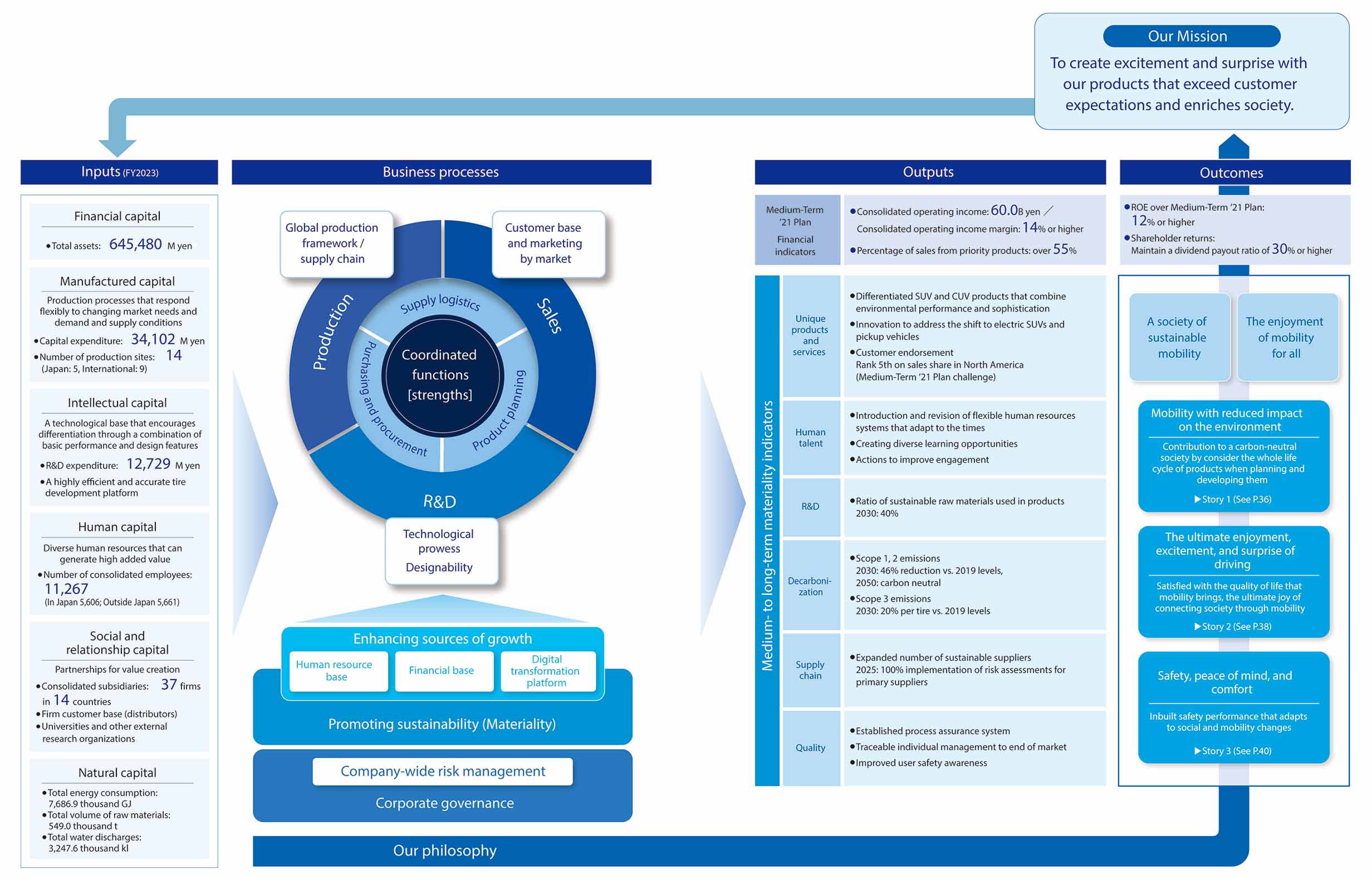
The Toyo Tire Group believes in the importance of organizing and disclosing our corporate philosophy, business model, governance, and business risks and opportunities to help promote a clearer understanding of the type of company we want to be in the future. As part of our value creation process, we have verbalized our six capitals, and defined the outputs generated through the utilization of these capitals and the outcomes that might impact stakeholders.
 Click to see larger image
Technical Strategy
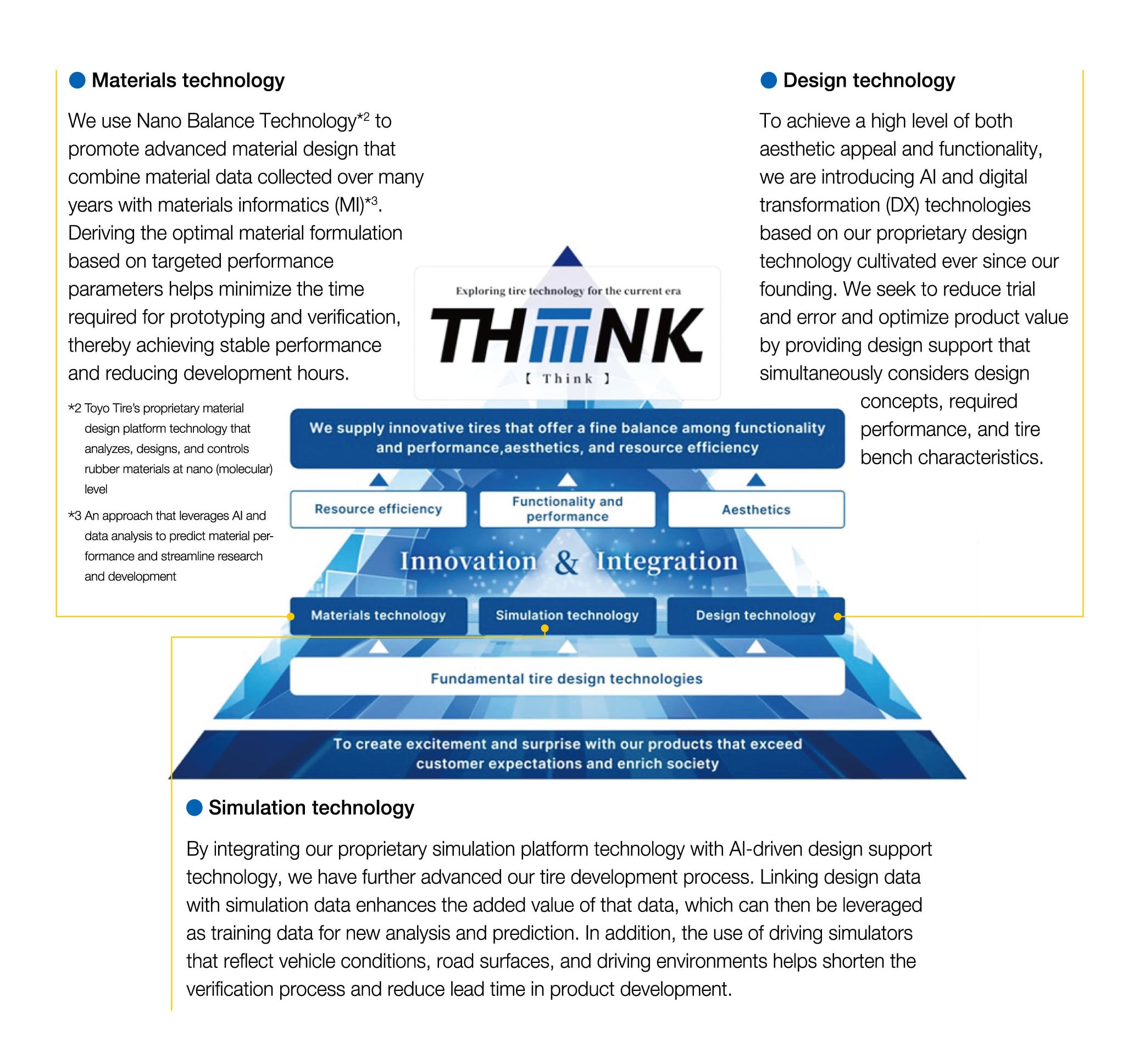
New THiiiNK technological framework
Among the various technologies we have cultivated over many years, we have identified materials technology, simulation technology, and design technology as our core technologies, and have continued to refine them through product development. We have established a new technological framework called THiiiNK that closely links and integrates these three technology areas, which had previously been developed independently, into a unified system. We will leverage this new technological framework as the fundamental philosophy and core technological foundation for next-generation tire development.
Technological innovation surrounding next-generation mobility, including the growing adoption of EVs, advances in autonomous driving technology, and the progress of Software Defined Vehicle strategies*1, is currently accelerating. As a result, the performance and value required of tires are becoming increasingly sophisticated and diverse. In addition to further improving quietness, fuel efficiency, and wear resistance, there is also a growing need to develop, with both precision and speed, products that meet new functional requirements such as sensor integration and real-time data connectivity. THiiiNK is an approach that addresses these challenges by effectively utilizing high value-added data based on our platform technologies, thereby evolving the very nature of technical development.
- *1 A strategy that controls and updates vehicle functions through software to enhance performance and offer new services
Collaboration among global R&D bases
The Toyo Tire Group has R&D bases in Japan, North America, and Europe, and we are enhancing our global R&D capabilities while also addressing technical issues related to specific regional market characteristics and usage environments. In Europe, with the aim of further strengthening our competitiveness, we are consolidating our R&D function in Serbia, where we already have production and sales functions, establishing a European structure with closely integrated technological capabilities.
Our R&D function in Serbia serves as a center for technical refinement that perfects material design and processing technologies through compliance with strict regulations and response to third-party evaluations. The sophisticated materials and processing technologies cultivated in Serbia are being deployed across R&D functions in both Japan and North America, and reflected in each region’s product development processes. Through such tripartite R&D cooperation and knowledge-sharing across the globe, the Group seeks to strengthen its technological prowess on a globally integrated basis and improve development efficiency, and ultimately facilitate the continuous and rapid development and launch of high value-added products.
The Technical Center in Japan is responsible for overseeing and advancing the platform technologies underpinning the THiiiNK framework and serves as the Group’s R&D hub, including talent development. We help enhance technological prowess and sustainable value creation by consolidating regionally developed technologies and expertise into a common stock of technology assets that can be systematically shared and expanded across the Company.
The R&D Center in North America, firmly rooted in the local market, leverages its market proximity to quickly develop products that reflect local customer needs and usage environments. The center evaluates and verifies technologies and products based on actual driving data to enhance technology implementation and accelerate product commercialization, while also helping to boost market competitiveness.

Developing high-value-added tires
Toyo Tire’s high-value-added tire development revolves around three technology categories: wide light truck tires (WLTR), ultra-high performance tires (UHP), and truck and bus radial tires (TBR). We develop material technologies, structural designs, and evaluation and analysis technologies that are tailored to their respective usage environments and performance requirements. The sharing and integration of this tailored technical and evaluation expertise across our global R&D bases is working to promote the adoption of universally applicable technologies and the consistent creation of high-value-added products.
For WLTR, we are pursuing more sophisticated structural designs with a focus on performance balance and uniformity in order to facilitate stable driving performance even in tough usage environments. We also ensure consistent basic performance, such as handling stability and wear life, by optimizing tire design and controlling quality variation. In terms of pattern design, we promote the development of high-value-added tires that balance performance and design by considering the aesthetic appeal of products that have already met their performance requirements.
For UHP tires, we are developing technologies that combine material, simulation, and processing technologies to satisfy increasingly sophisticated performance demands including handling and safety at high speeds. We also use analysis technology to improve the accuracy of rubber material design and structural design. We conduct multiple checks during the development phase including evaluations of actual vehicles and bench tests to ascertain whether the intended design performance is being achieved in practice. Promoting integrated materials development, analysis, and evaluation allows us to develop more advanced UHP technologies that offer both high performance and reliability.
Regarding TBR, leveraging our strength in structural design technology, we are advancing our design technology with a focus on durability and wear resistance to facilitate the consistent demonstration of required performance even under demanding usage conditions. We are working to improve overall tire performance balance by optimizing tire structure based on driving conditions and long driving periods.
Furthermore, we are elevating the quality and shape stability of the casing, which can withstand repeated use, to an even higher level. These efforts are helping enhance the reliability of our TBR technology for long-term use.
Product Brand Strategy
Improving product functionality through motorsports activities
We position motorsports activities as an opportunity to refine our technical capabilities, enabling us to apply insights gained under extreme real-world driving conditions to product development.
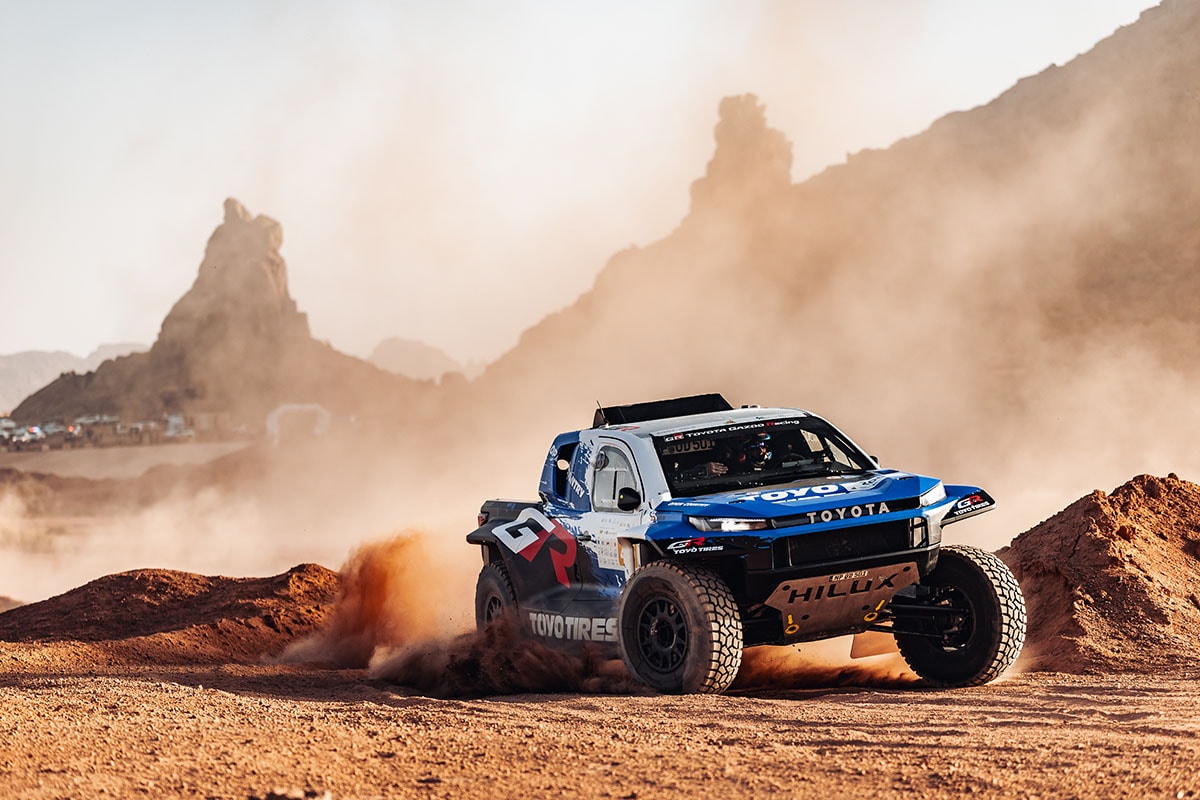
In the off-road category, in order to hone the performance of our SUV and pickup truck tires, we provide our OPEN COUNTRY series tires (including racing models) to teams competing in some of the toughest races including the SCORE Baja 1000, where most of the course runs across deserts and only around a half of entrants finish, and the Dakar Rally, reputedly the most grueling off-road endurance rally in the world. The learnings from these competitive events are used to develop rubber composition and internal structure that ensure high durability on rough terrains, and design features and bead structures that minimize tire damage caused by impacts during high-speed driving.
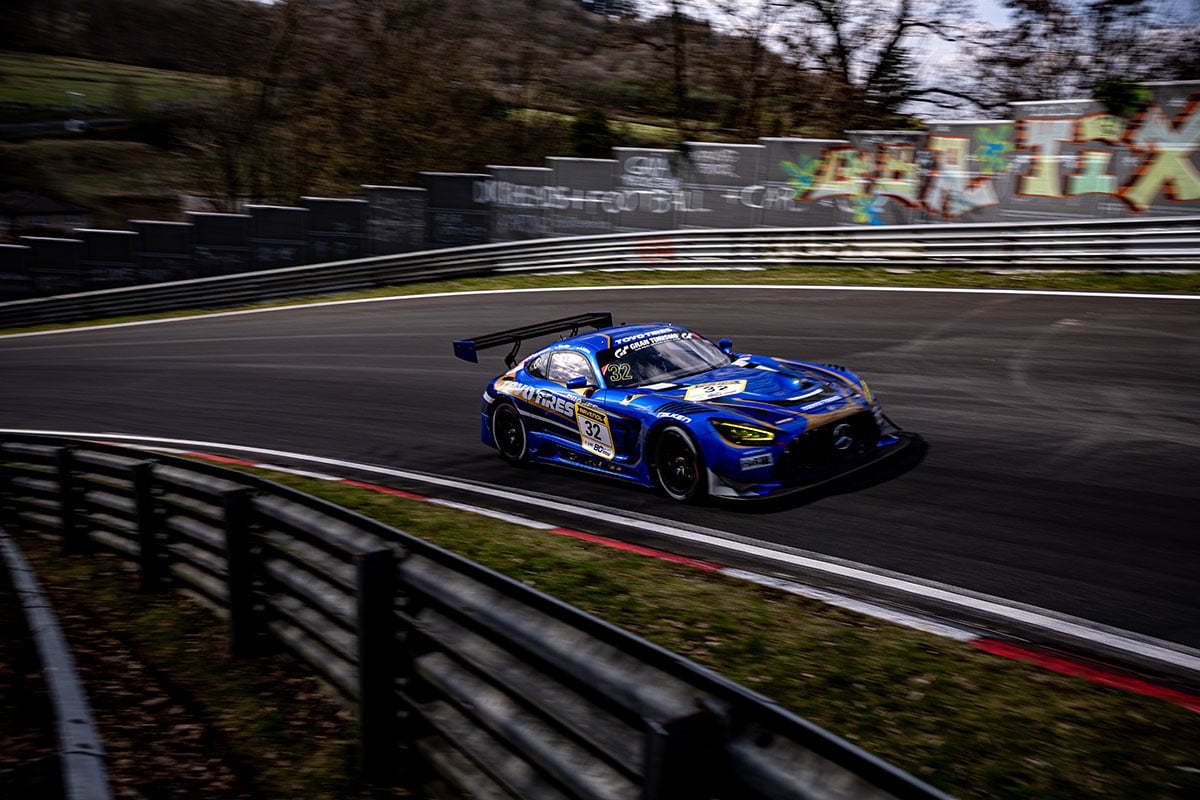
In the on-road category, in order to hone the high dynamic performance required of ultra-high performance (UHP) tires, we compete in races at the Nürburgring in Germany, renowned as one of the world's most demanding race tracks, with vehicles fitted with special PROXES racing tires.
With 300 meters of elevation change and more than 170 corners, the North Course of Nürburgring is renowned for its difficulty, and the lap times and performance quality achieved on this course are important indicators for assessing the ultimate performance of UHP tires. We use the data and insights gained through races under these arduous conditions to improve the handling, stability and durability of our products during high-intensity driving at high speed. These learnings from motorsports activities are also used in product development. An example of that is new materials developed and tuned through racing activities that have now been incorporated into commercial tires in stages.
Going forward, with the goal of competing in the top class of each race and achieving overall victories, we will focus on product development centered on wide light truck (WLTR) tires in the off-road category, working to deliver tires that combine high functionality with unique styling.
In the on-road category, we will further verify and refine our accumulated expertise at an even higher level, thereby enhancing the dynamic performance of our UHP tires and leveraging these achievements to increase our brand value and strengthen our market presence.
Sales Strategy
Sales strategies for priority products
Under the Medium-Term '21 Plan, to further strengthen our competitive edge, we have promoted a priority product sales strategy that stands apart from the pursuit of a full product line or scale. Under this policy of aiming to maximize profit through thorough, consolidated profitability management across each market globally, product development, production, and sales functions have worked as one to deliver high value-added products tailored to the characteristics of each market.
Priority products are an original tire product category that epitomizes Toyo Tire's strengths, comprising new, core, and differentiated products. Our sales function has worked to enhance the quality of its product mix in each region in line with local market characteristics, using the percentage of sales from priority products as a key indicator when developing sales activities. The Medium-Term '26 Plan continues with this approach, pursuing profitability-oriented growth.
Regional sales strategies
North America
In North America, we seek to maintain and enhance Toyo Tire’s presence and expand sales with a WLTR-focused branding strategy. At the same time, we use TBR as a growth driver to strengthen supply capacity and profitability and sharpen our competitive advantage.
・Consolidating our WLTR presence and promoting further growth
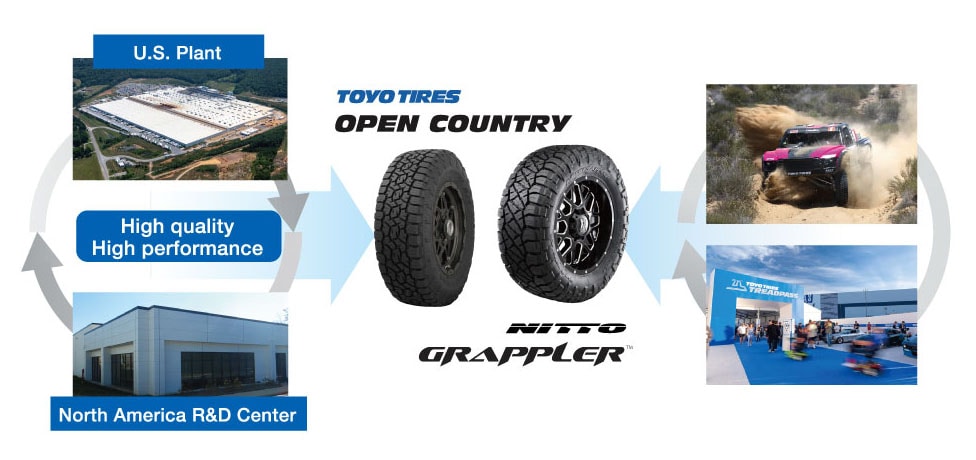
The Medium-Term ’21 Plan focused on strategic product development centered around OPEN COUNTRY (TOYO TIRES) /GRAPPLER (NITTO) tires and on the offering of tailored promotions to strengthen dealer relationships. This strategy propelled Toyo Tire rise to No.5 on the U.S. sales table, and helped steadily increase WLTR presence in the North American market.
Demand for wide light truck tires (WLTR) is expected to continue expanding steadily, supported by the upward trend in vehicle sales in the North American market and the rising rate of WLTR installation on new vehicles from major automakers. Traditionally, users have focused on WLTR designability and durability but in recent years, more and more users are also interested in basic performance elements such as better wet performance and rolling resistance. While our WLTR products place particular emphasis on sophisticated features, we are also advancing product development that responds to the market's performance requirements, and we expect demand for our products to remain firm as a result. In North America, market data on price, size, and other factors is readily accessible, and we believe that swiftly and accurately capturing customer feedback will be key to strengthening our competitiveness.
The underlying policy in the Medium-Term ’26 Plan is to maintain and enhance WLTR presence, in which the Group has the competitive edge, and promote further growth. We intend to strengthen our brand strategy centered around OPEN COUNTRY/GRAPPLER tires to better compete with leading brands. We will also aim to expand WLTR sales through marketing designed to foster a passionate WLTR fan base. Ultimately, our aim is to increase WLTR sales volume over the medium-term plan period by a minimum of 10% compared to 2025. In terms of frontline sales, we remain committed to our fundamental approach of staying attuned to market needs and developing a swift response, rapidly bringing the necessary sizes to the market in line with the timing at which demand materializes.
・Market offensive that leverages TBR strengths
Under the Medium-Term’21 Plan, we focused on expanding the sales of truck and bus radial tires (TBR) and delivered firm sales performance over the plan period.
While our TBR products have earned strong recognition and support in the market, we have not always been able to adequately satisfy these expectations due to certain constraints on our supply capacity.
The current Medium-Term ’26 Plan positions the expansion of our TBR market share as a key growth driver and aims to expand its sales volume by 50% compared to the 2025 level. In terms of supply, in addition to our Kuwana Plant in Japan, we plan to build a new TBR plant to strengthen our supply capacity.
Europe
Having consolidated production, sales, and R&D functions in Serbia, we will now turn our attention to strengthening our brand power by integrating these functions, improving supply capacity and lead times by pursuing local production for local consumption, and expanding sales and accelerating revenue growth in the European market by focusing on UHP.
・Consolidating sales functions in Serbia
In the European market, during the Medium-Term '21 Plan period, we consolidated our sales companies previously located across multiple regions into a newly established sales company in Serbia, where our production plant is located, achieving a significant streamlining of our cost structure. Going forward, by advancing the consolidation of our production, sales, and R&D functions in Serbia, we will swiftly build the foundation needed to strengthen our competitiveness in the European market.
Under the Medium-Term '26 Plan, we will fully capitalize on this structure to take a more aggressive approach to growth in the European market. While we have earned a certain degree of recognition through third-party evaluations such as magazine tire tests and motorsports activities, we recognize that we have not yet fully conveyed the technical value behind our products. To address this, our production, sales, and R&D functions will work as one on the marketing front to clearly showcase a strengthened brand power backed by technological excellence.
These strong results in magazine ratings and high-end motorsports, together with our stable supply system and low complaint rate, give our frontline personnel a strong sense of confidence, motivating them to pursue further quality and continuous improvement. We believe this will help establish a virtuous cycle in which heightened awareness enhances quality and performance, encourage stronger external evaluations, and generate even stronger results. Leveraging the strengths generated by coordinating production, sales, and R&D initiatives from a single location will enable us to rapidly share these strong results, and drive more organic and sophisticated ideas and activities.
・Establishing local production for local consumption frameworks
Under the Medium-Term '21 Plan, product supply to the European market was based primarily on shipments from our plant in Japan, which required a certain lead time from order receipt to delivery.
Establishing a local production for local consumption framework will enable us to substantially shorten supply lead times to the European market, while also allowing for a broader product lineup. Going forward, this accelerated supply will drive a major shift in both the quality and tactics of our sales.
Japan
・Focusing on core brands and optimizing sales structures
In the Japanese market, we focus on building relationships with sales partners who share our approach and can work together with us to deliver products to customers. Under the Medium-Term '21 Plan, we worked to build win-win relationships that would lead to sustainable growth over the long term. Through measures such as consolidating sales outlets and enhancing call center functions, we fundamentally overhauled our sales structure, driving this restructuring consistently in line with our market strategy. As fixed cost structures have been reviewed and sales efficiency has improved, a robust business foundation is steadily taking shape in our operations in Japan.
Against that background, under the Medium-Term '26 Plan, we will continue to strengthen our competitiveness by focusing on core brands and developing unique products. On the sales front, as in the European market, we will place emphasis on promoting high value-added products. We will further deepen the efficiency gains achieved through the sales structure reforms carried out during the Medium-Term '21 Plan, leveraging AI and digital transformation (DX) to build a more sophisticated sales framework with greater quality, while further accelerating our shift toward a compact and resilient profit structure. We recognize that establishing OPEN COUNTRY and PROXES as our two flagship brands and using them to elevate the presence of the TOYO TIRES brand is the key to achieving sustainable growth in Japan.
Other markets
・Acquiring brand-conscious customers
In the Southeast Asian market, we will steadily capture demand by appealing to the tastes and preferences of brand-conscious, discerning high-end customers through our product strength and brand power, while working to strengthen our sales base. In recent years, the spread of EVs has helped boost demand for large-diameter tires, one of our focal areas, and this has proved a welcome tailwind for us. We consider product strength and stable supply to be key drivers of our competitive edge, and we will build a flexible supply system that combines supply from both Malaysia and Japan.
In Malaysia, we have leveraged our strength in local production for local consumption to expand both replacement and OEM sales channels and secure the No.1 market share. Pickup trucks remain consistently popular in the market, and our tire lineup complements those vehicles well, enabling us to readily demonstrate our product advantages there.
Thailand is a highly competitive market, but given the high proportion of pickup trucks, it is a market where we can leverage our strengths, and we will continue to aim for expanding our presence there.
Production and Supply Strategy
Global production and supply system
In the early stages of the Medium-Term '21 Plan, the global pandemic and the resulting lockdowns affected production activities across every industry. Our Group was not immune to this impact and was forced to temporarily shut down plants around the world. Even so, in order to meet expectations of us as an essential business, we put in place production arrangements suited to conditions in each region and continued to fulfill our responsibility to supply.
Amid growing workforce turnover, we also faced challenges in employee retention in Europe and the United States. We focused on improving productivity to minimize the impact on our business, and also succeeded in getting supply from our newly established Serbia Plant on track. Furthermore, we seized the opportunity to carry out a disciplined replacement of assets to strengthen our competitiveness, including the closure of the Silverstone Plant in Malaysia and an automotive parts plant in the United States.
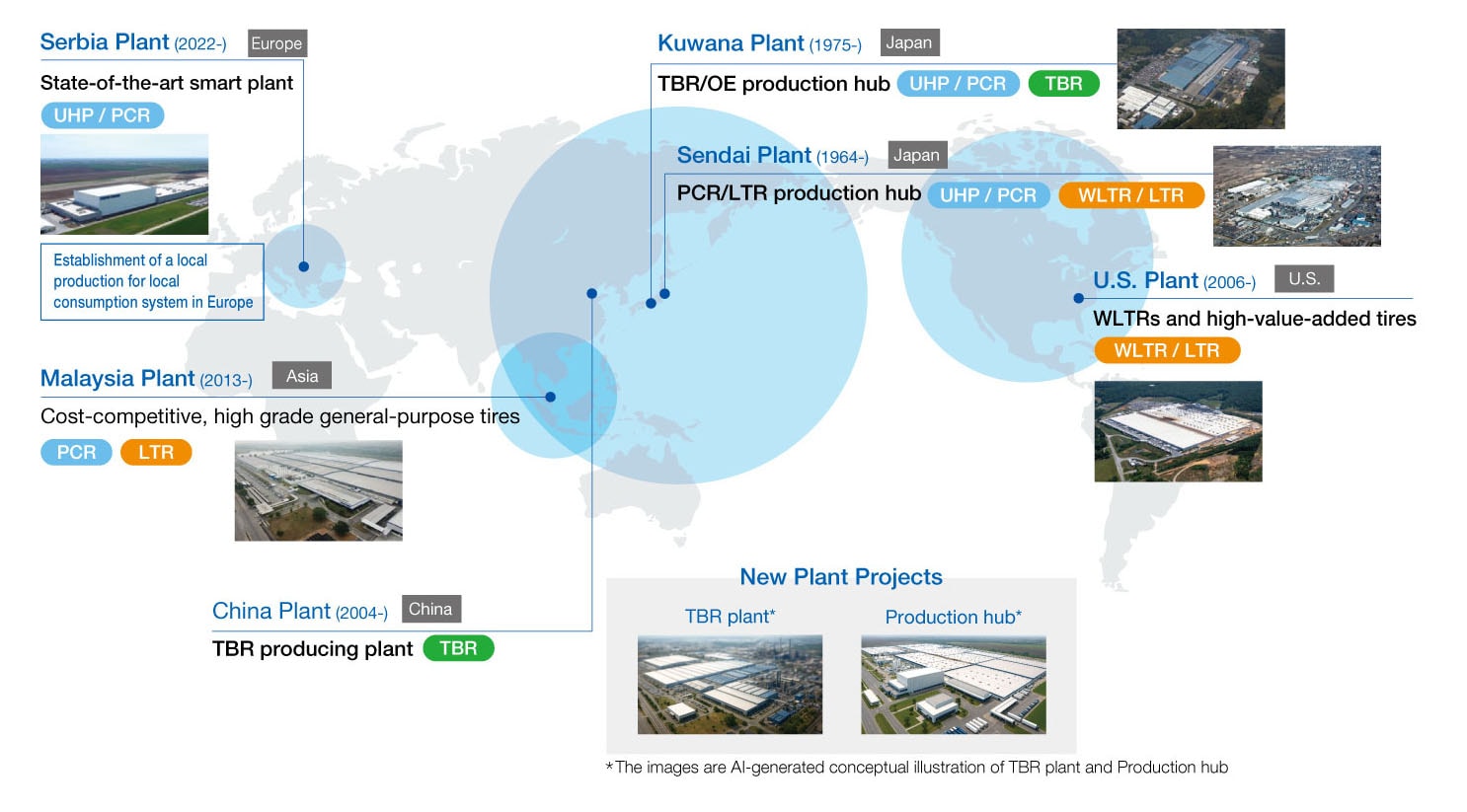
In the Medium-Term ’26 Plan, while maintaining the basic principle of local production for local consumption, we are evolving our global production system further so that production bases in different regions can complement one another, enhancing supply capability based on market needs. We are also strengthening the inter-functional collaboration between production, sales and R&D within each region to ensure that market trends and customer needs captured are accurately incorporated into products. By managing all processes from product development to production and supply in such an integrated manner, we can improve our responsiveness and competitiveness.
As each market has a distinct demand structure and product characteristics, our plants in Japan, North America, Europe and Asia are each assigned specific roles and functions to supply their local market as a priority with maximum supply flexibility and efficiency. Furthermore, we will strive to optimize supply allocation in accordance with demand-supply dynamics, which will improve the operational stability and profitability of the business as a whole.
Building on our unique Advanced Tire Operation Module (A.T.O.M.) manufacturing method, our U.S. plant is actively introducing and utilizing the technical expertise and know-how accumulated at our other bases to elevate quality and productivity to the next stage and further strengthen our competitiveness.
Human Capital Management
Medium-Term ’26 Plan: Evolving and deepening
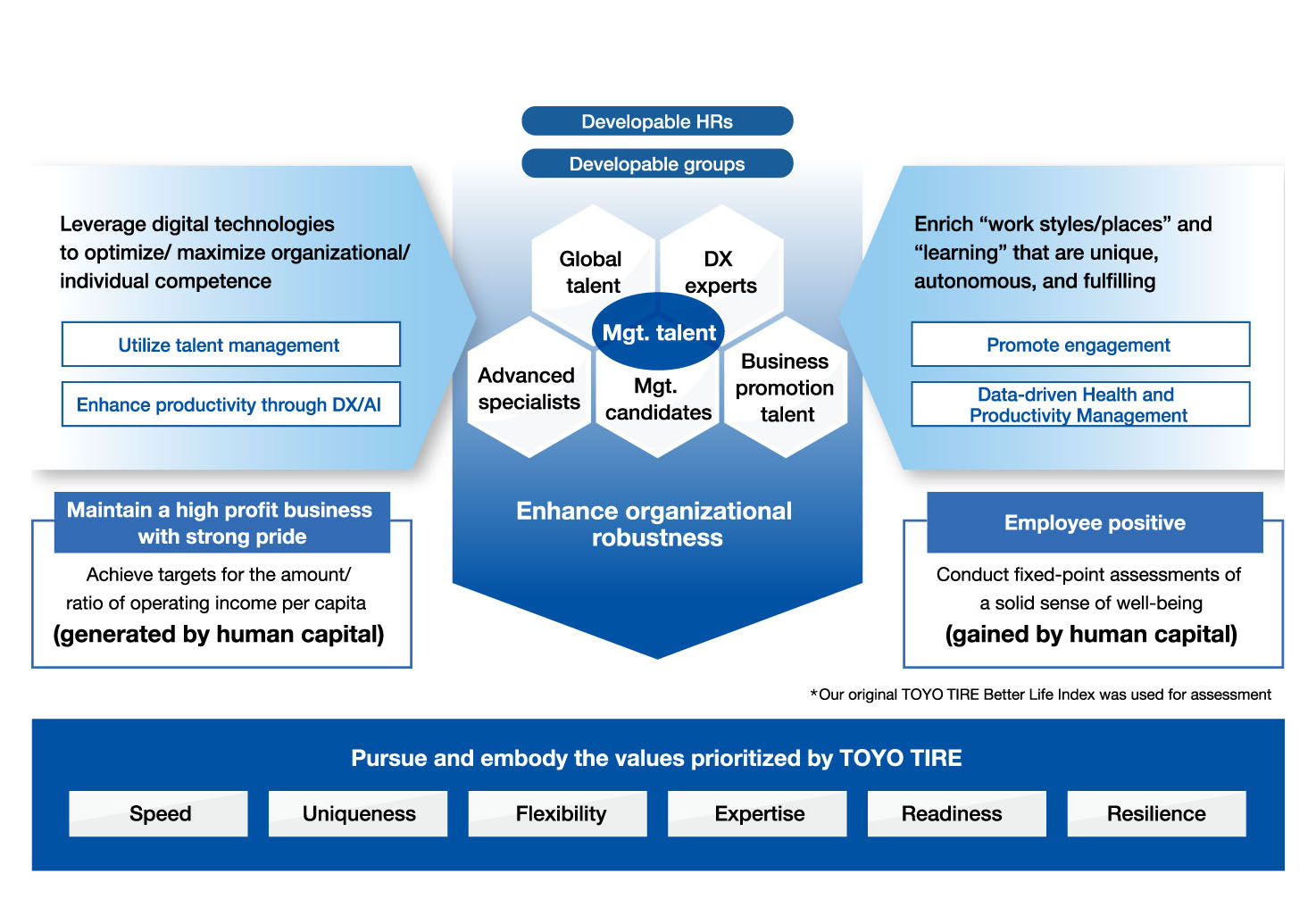
Under the Medium-Term ’26 Plan, we will further evolve and strengthen our human capital strategy, and fully embrace human capital management across the Toyo Tire Group. Our goal is to nurture talents that can pursue and embody the values that are important to us: speed, uniqueness, flexibility, expertise, readiness and resilience. At the same time, we will make our organization more robust so that these talents can function cohesively as an organization. In order to maintain a proudly high-profit business that is positive for employees, we will make full use of a talent management system to develop talents that can play a role in maintaining and expanding the Group’s management and business operations, improve engagement to motivate these talents, and practice data-driven health and productivity management to ensure they can always perform to their full potential. We will implement these actions speedily and steadily in order to build a solid foundation of human resources that can help to achieve the targets of an operating income of 120 billion yen or higher and an operating income margin of 18% or higher by the final year of the Medium-Term ’26 Plan (fiscal 2030).
For human capital management, we have defined key goal indicators (KGIs) for each goal. To maintain a high-profit business with strong pride, we track the operating income and margin targets per capita (generated by human capital). To create a positive environment for our employees, we track the strength of the employees’ sense of well-being (gained by human capital). In order to measure the sense of well-being, we have devised our own metric, the Toyo Tire Better Life Index, to assess the level on an ongoing basis.